Ryze Design Studio
Last Updated:
4 min
read
TL;DR
Messaging translates positioning into language buyers can follow.
A strong system keeps website, sales, onboarding, and campaigns aligned.
The core parts are audience, value proposition, proof, voice, and objections.
Start with buyer language and the clearest possible claim.
Most SaaS companies have a positioning problem hiding inside a writing problem. The website copy sounds reasonable. The deck has a clear flow. The team can walk anyone through the product in a 30-minute call. But ask a buyer to explain what the company does in one sentence, and the answer comes out tangled.
Messaging is the problem. It shows up more often than most teams expect.
Brand messaging is the set of words, ideas, claims, and proof points a brand uses to explain what it does, who it serves, what problem it solves, and why buyers should believe it. A tagline, a slogan, a homepage headline, a campaign theme – those are outputs. Messaging is the system underneath them.
When the system works, the homepage makes sense, the sales deck follows the same logic, onboarding copy feels consistent with what the buyer was sold, and the marketing team can reuse the same story every campaign cycle. When the system is absent, each team writes its own version and the product becomes harder to understand the more people encounter it.
What Brand Messaging Means

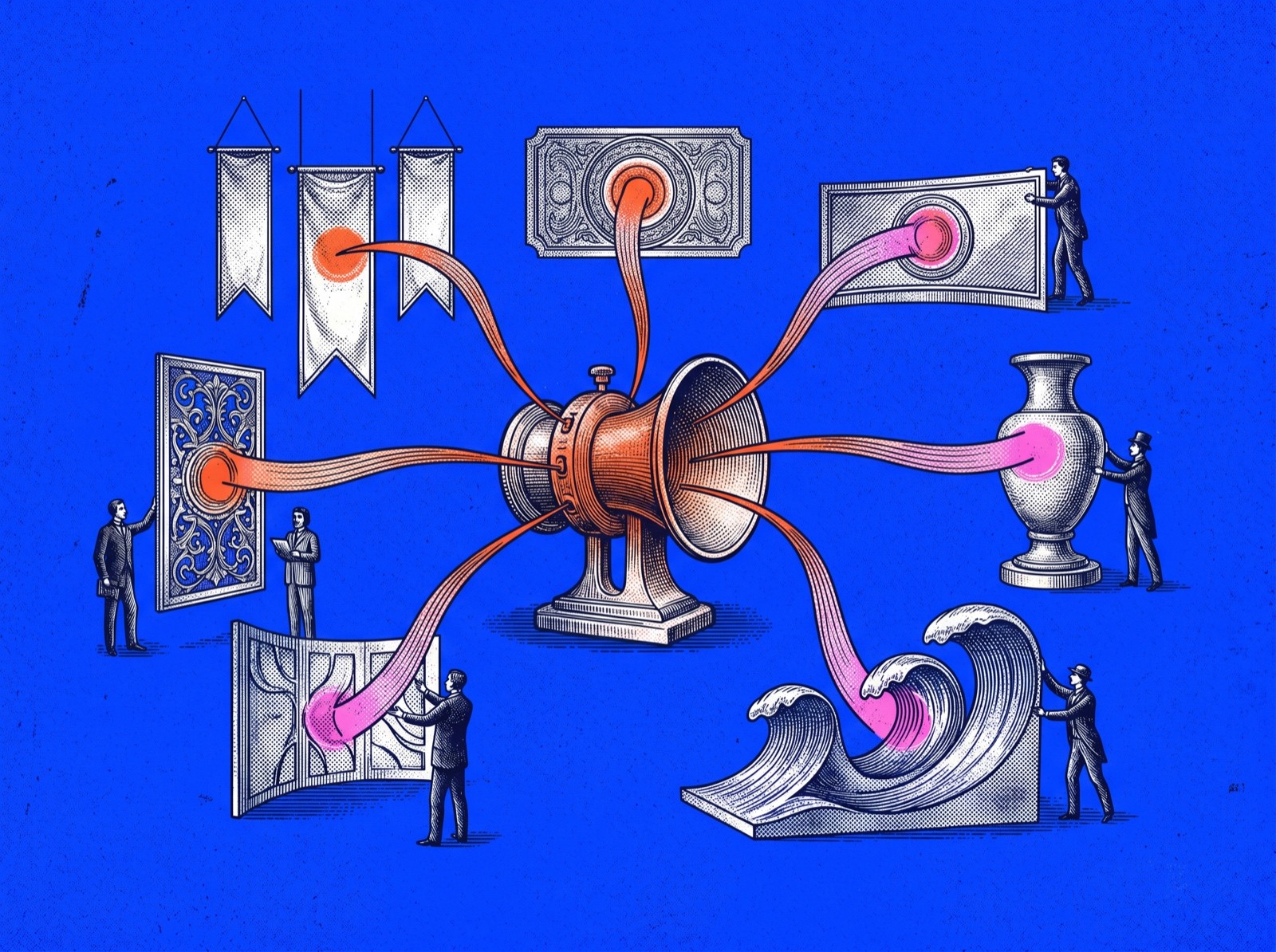
Think of brand messaging as the translation layer between your positioning strategy and the words that reach buyers.
Positioning is the strategic decision: the problem you own, the audience you serve, the space you want to hold in the market. Messaging is how that decision shows up in language. It shapes the homepage headline, the sales follow-up email, the product tour copy, the security page, the investor slide, and the onboarding welcome message. The same core idea, expressed clearly across different contexts, in different words.
A useful messaging system gives your team something they can actually use. A founder should be able to explain the product at a conference. A sales rep should be able to handle a competitor question without improvising. A campaign should reinforce what the website already said. When each of those moments requires a different script, the messaging is not doing its job.
Inside a larger SaaS branding system, messaging is where the brand's strategic position becomes language buyers can understand. It gives your website, sales deck, product pages, and launch campaigns a shared way to explain why the company matters.
Why Messaging Matters
Products are getting harder to explain as they get more capable.
Most SaaS products are now layers on top of layers: integrations, AI features, workflow automations, configuration options, and role-specific views. The product does a lot. The question is whether a buyer can see what it does for them in a few seconds.
Clear messaging does the work of translation for the buyer. Here is the problem, here is what changes, here is why we can deliver that. They should not have to piece it together themselves.
Your sales team is explaining the product dozens of times a week. If the messaging is clear, those conversations have a shared structure. If it is vague, every rep improvises their own version, discovery calls take longer, and the buyer hears a different story depending on who picks up.
The internal cost compounds. When a company cannot explain itself with a shared set of ideas, small problems pile up. Product teams write UI copy that does not match what marketing promised. Customer success explains the value differently than sales did. A new hire joins and cannot figure out what the company is really saying. Messaging the whole team can use is how companies avoid that kind of slow-accumulating confusion as they grow.
Messaging vs. Positioning
Positioning and messaging are related, and they work at different levels. They get conflated often enough that it is worth being precise about which is which.
A position is a claim that only holds for this product. It must be true of yours and false if a competitor's name goes in its place. A claim that works equally well with any name in your category describes the category, not your product.
Messaging has done its job when the buyer can say back what you mean in their own words, without losing anything. That restatement, in their language, is how you know the message got through.
Positioning is the strategic decision. It defines where you want your product to sit in the buyer's mind, relative to their alternatives. It answers: for whom, against what, on what dimension do you win.
Messaging is the expression of that decision. It translates the positioning into language the buyer encounters.
Here is a practical example. Your positioning says: "the simplest way for finance teams to control spend without losing flexibility." That positioning decision should then show up as a homepage headline, a core benefit statement in the sales deck, a pain point framed in the outbound email, a line in the pricing page explaining why the plan structure exists, and a reassurance in the demo that speaks to the CFO's concern about visibility. Different words, same direction.
Positioning usually stays more stable than messaging. The strategic decision may hold for years. Messaging adapts. It shifts by audience, by buying stage, by channel, by product maturity. A message to an enterprise security evaluator looks different from a message to a startup founder, even when they are both evaluating the same product.
Messaging vs. Copywriting
Messaging defines the strategy. Copywriting executes it.
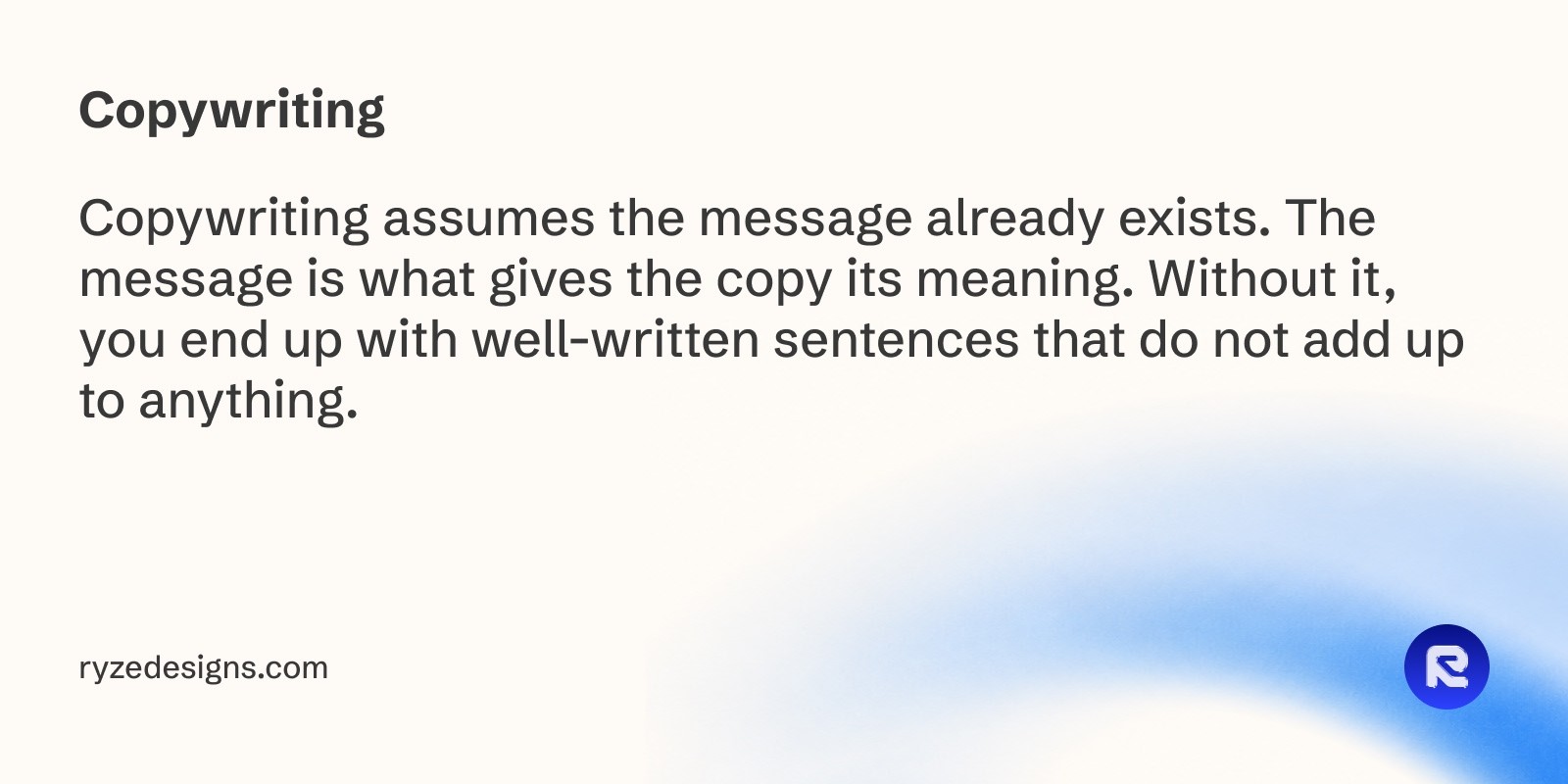
Messaging answers: what do we claim, for whom, with what evidence, in what order, in what kind of voice. Copywriting turns those answers into a finished homepage, a landing page, an ad, an email sequence, or a product tooltip.
This distinction matters because a company can have very polished copy sitting on top of weak messaging. The words sound fine. The sentences are clean. But the buyer finishes reading and still is not sure what the product is for, who it is meant to help, or why it is different from the three competitors they already looked at.
Weak strategy underneath clean copy still leaves the buyer confused. Build the messaging layer first, then write.
The Core Parts of a Messaging System
A useful messaging system is a set of decisions that help teams communicate with more consistency and less friction.
Here are the main components:
Audience. Who the product is built for, what role they play, what they care about, and how they think about their alternatives.
Positioning. The strategic claim about where the product sits in the market and why it is different.
Value proposition. The specific outcome the product creates for the buyer and why that outcome is worth the switch.
Main message. The clearest, most complete version of what the brand wants buyers to understand. Simple enough for the homepage. Sturdy enough to guide the sales conversation.
Message pillars. The major themes that support the main message. Each pillar connects a buyer problem to a product benefit with real proof behind it.
Proof points. The features, workflows, case studies, integrations, certifications, and customer outcomes that make the claims believable.
Brand voice. How the brand sounds consistently over time.
Tone guidance. How the voice adjusts by context, audience, and purpose.
Objection handling. The questions and doubts buyers bring, and how the messaging addresses them directly.
Words to use and avoid. The language patterns that sound right for the brand and the specific phrases that should not appear.
The audience definition tells you who you are writing for. Positioning tells you what angle to take. The value proposition tells you what matters most to the buyer. Pillars give your team repeatable themes. Proof makes the claims stick. Voice and tone guidance ensures the whole thing feels like one company. Together, they give your team a shared language for explaining the product – rather than leaving every person to write their own interpretation and call it the brand.
Start With the Buyer
Strong messaging starts with the problem. The product comes later.
Before you write a single line of messaging, you need to understand how the buyer thinks about their situation – specifically how they experience it day to day, in their own language, before your product enters the picture.
Some questions worth grounding yourself in:
What problem does the buyer already know they have?
What problem do they not yet know how to name?
What language do they use in sales calls, reviews, and support tickets?
What alternatives are they considering, and why?
What outcome do they want, who in their organization will judge that outcome?
What risks worry them? What happens if this does not work?
That last one matters more in B2B and SaaS than people expect. Buyers are evaluating how the product will land internally, not just whether it works. There is a boss to report to. A team that will push back on any new tool. A budget that needed four approvals to unlock. The messaging that acknowledges that pressure is the messaging that connects.
For most SaaS products, the buying decision involves more than one person. A user who needs the product, a manager who approves the budget, a technical evaluator who needs to know how it integrates, a procurement team asking about security, and in larger deals, a legal team with their own checklist. The core message should stay consistent across all of them. The supporting message shifts by role, surfacing the dimension of value that matters most to each person in the room.
Clarify the Value Proposition
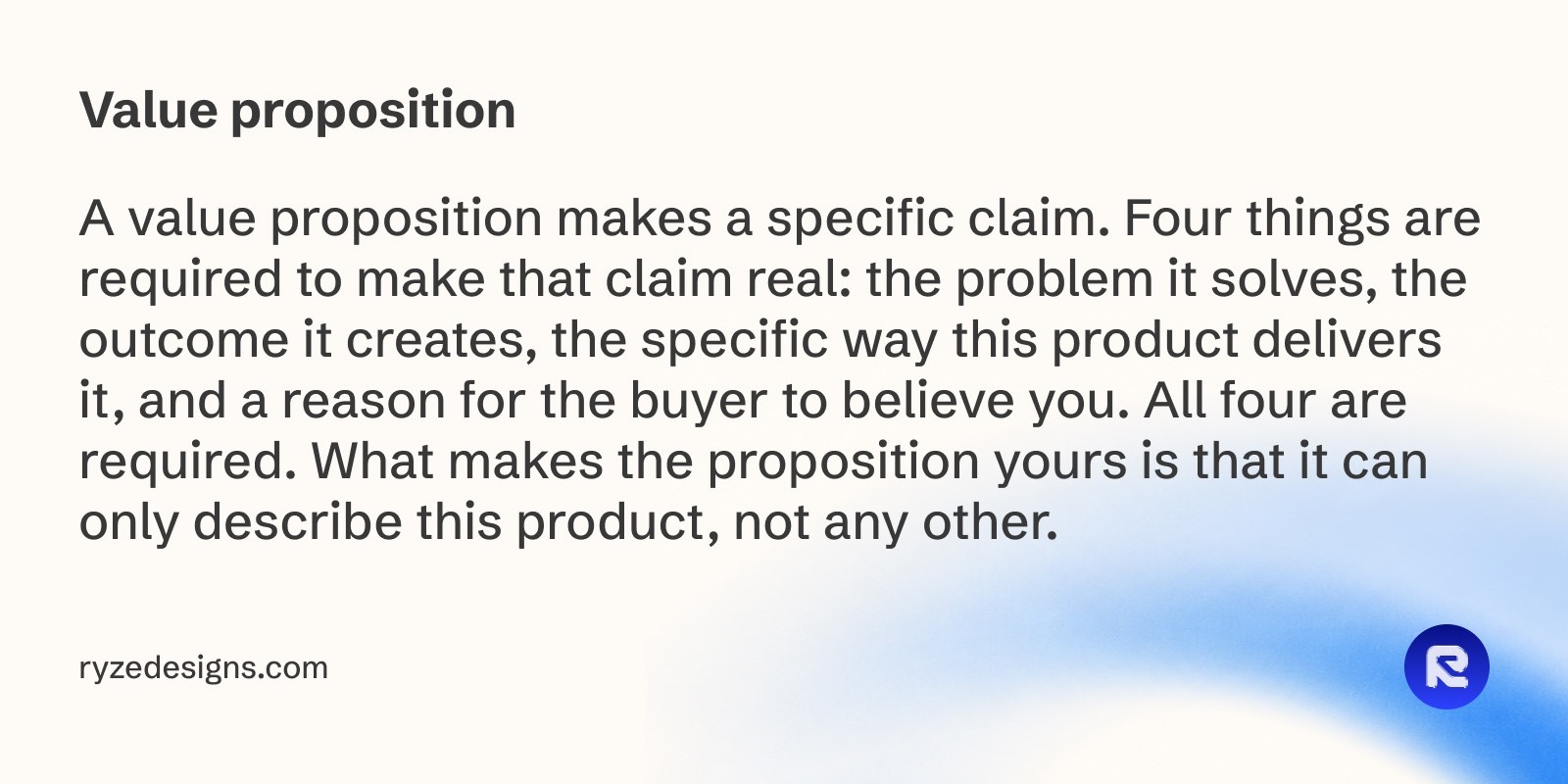
The value proposition is the answer to why the product matters to a specific buyer. A tagline is a distillation of that answer, often written last, after the underlying argument is clear.
A useful value proposition connects four things: the problem, the outcome, the product's distinct method or advantage, and a reason to believe it.
Consider the difference between these two:
Weak: "We help teams save time with an AI-powered platform."
Stronger: "We help support teams cut repetitive ticket work by turning approved answers, workflows, and customer context into guided responses agents can trust."
The second version names the buyer, the specific problem, the mechanism, and the outcome. It is more specific and harder to copy. A competitor cannot put their name on it without lying.
A value proposition that could belong to any company in your category is doing very little work. Specificity is the signal that you actually understand the buyer's situation.
Define the Main Message

The main message is the clearest version of what you want buyers to understand about the product.
It should answer five questions without making the reader hunt:
What do you do?
Who is it for?
What problem do you solve?
What outcome do you help create?
Why should the buyer believe you?
The main message runs deeper than a homepage H1. It might inform the H1, but it is more complete than a headline. It is the version of the product story that helps marketing brief an ad agency, that gives a rep a spine for their discovery call, and that grounds the product manager when they are writing a release announcement.
Write it plain. No jargon, no modifiers that do not earn their place, no claims you cannot back up. If it sounds like something a competitor could say just as easily, rewrite it until it cannot belong to anyone but you.
Build Message Pillars
A pillar is a claim with something real behind it. That means a specific feature, workflow, outcome, or piece of evidence that makes the claim true or false. A claim with nothing behind it is just a feeling about the product. The pillar earns its place when the support is something you can actually point to.
Message pillars are the major themes that support the main message. Each pillar represents a significant dimension of value the product delivers, connected to a real buyer problem and backed by something real.
A useful pillar has four parts: the claim (what you are saying the product does), the problem (the buyer situation that makes it matter), the benefit (what the buyer gets when the claim is true), and the proof (the specific feature, workflow, integration, or outcome that supports it).
Here is an example:
Pillar: Faster campaign planning
Problem: Marketing teams lose hours moving briefs, assets, approvals, and timelines across separate tools and email threads.
Benefit: Teams can plan, brief, and launch campaigns with fewer handoffs and more clarity across the team.
Proof: Shared briefs, approval workflows, asset libraries, and in-platform campaign status tracking.
Pillars earn their place by connecting a buyer problem to something the product actually does. "We care about simplicity" is a sentiment. "Simpler setup than Salesforce, without losing the CRM features your ops team actually uses" is a pillar.
Each pillar gives the team a theme they can use. Marketing builds a campaign around it. Sales builds a talk track. Product writes a feature release announcement that connects to the same idea. They do not need to use the same words. They need to be drawing from the same strategic well.
Add Proof Points
A proof point is a fact that connects directly to a claim. The connection holds when the fact changes whether the buyer believes the claim. A fact that has no effect on any claim in your messaging belongs somewhere else.
Every claim needs something behind it. The moment a claim floats without support, the buyer's trust goes the other direction.
Proof points can come from many places:
Product features and how they work
Workflow specifics that show the product in action
Customer outcomes and case study results
Integrations with tools the buyer already uses
Security certifications and compliance scope
Performance benchmarks
Implementation timelines
Support model and response commitments
Founder or team expertise in the specific category
For AI products, proof deserves more attention than most teams give it. "Powered by AI" has become background noise. The claims that actually land are more specific: what data the model draws on, who reviews the outputs, what controls admins have, what the product does when it is uncertain, and what limitations are clearly stated.
Buyers have been burned enough times by AI products that overpromised and underdelivered. The messaging that earns trust explains how the technology actually works – and where it stops.
Shape Voice and Tone
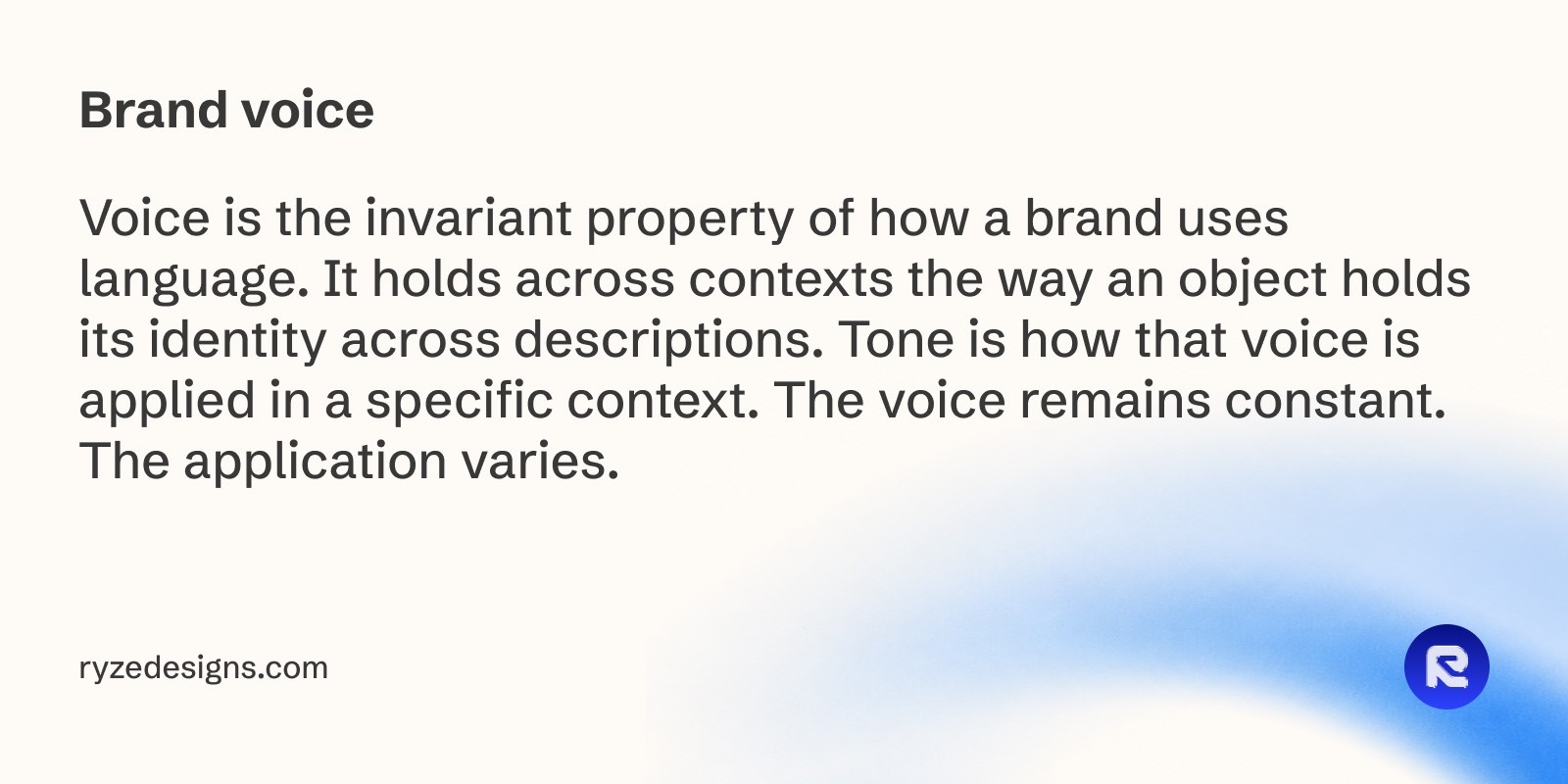
Brand voice is how the company sounds over time. Tone is how the voice adjusts by situation.
Conflating the two causes problems. A company should have one voice, consistent across every context. The tone, however, should flex.
The homepage may be clear and confident. The security page may be direct and careful. The product onboarding copy may be brief and helpful. A launch announcement may be sharper and more energetic than a support article. None of this breaks the voice. It just applies the right temperature to the right moment.
The strongest brand voice sounds true to the company that made the product. Some of the most distinctive brands in SaaS sound like exactly what they are: precise, serious, and written by people who understand the problem deeply. That is its own kind of voice, and it is harder to fake than a clever tone of voice document with too many examples of banter.
Create a Messaging Framework
A framework makes a decision available. A decision is available when it is stated such that another person can act on it without the original decision-maker present. A document that requires interpretation each time it is opened has not yet achieved this.
A messaging framework is the document that holds all of this together and makes it usable.
A practical framework includes:
Target audience and buying group
Buyer problem
Positioning statement
Main message
Value proposition
Message pillars with proof
Key benefits by role or persona
Proof points
Common objections and responses
Voice and tone guidance
Channel examples showing how the message adapts
Words to use and words to avoid
The real test of a framework is whether the sales team can open it on a Monday morning and find something useful. If the account executive, the marketing manager, the product manager, and the agency partner all read it and come away with the same understanding of how to explain the company, the framework is working. If each of them interprets it differently, it needs more specificity.
A framework that lives in a slide deck and never gets used is documentation for documentation's sake. Build for use.
Use Messaging Across the Brand
A clear messaging system should show up everywhere the brand communicates, without being copy-pasted everywhere without adjustment.
The core idea stays consistent. The expression changes by context.
Here is where messaging should shape the work:
Homepage: The main message, main pillars, and core proof in order of buyer priority.
Product pages: Pillar-level depth, feature proof, and specific audience benefit.
Pricing page: Value framing that justifies the tiers, going beyond feature comparison.
Sales deck: The narrative version of the messaging: problem, consequence, solution, proof, differentiation.
Demo script: Pillar-based structure so the demo tells the same strategic story the website started.
Landing pages: One pillar idea, one audience, one proof chain.
Email campaigns: Pillar rotation, objection surfacing, or segment-specific value framing.
Product onboarding: Messaging that matches what was promised in the sale.
Product UI and microcopy: Short, consistent, and written in the same voice.
Launch announcements: Main message plus the new claim, backed by proof, in the voice the brand already owns.
Case studies: Proof in narrative form, organized by the pillar the customer story supports.
Help center: Tone-adjusted but still consistent with the brand voice.
Hiring pages: Strategic messaging about the company, with specifics – the kind of work, the problems being solved, the people already there.
For visual identity to reinforce the message, the words and the design system need to point in the same direction. A brand that sounds precise but looks scattered creates doubt the buyer cannot name but will feel.
Test Your Messaging
Messaging needs to survive contact with real buyers before you treat it as final.
Some tests worth running:
The buyer clarity test. Can someone who has never heard of the product read the homepage and explain what it does in one sentence?
The sales test. Can the sales team repeat the core message in their own words without rewriting the whole thing? If they are constantly improvising, the messaging does not give them enough to work with.
The differentiation test. Remove the company name from the homepage. Could a competitor's name go in its place without the copy breaking? If yes, the messaging is still too generic.
The proof test. Does every major claim point to something real? A claim that floats without evidence is a liability the sales team has to carry into every conversation.
The channel test. Does the message still work when it shows up in an ad, a follow-up email, a deck, and the product tour? Or does it only make sense on the homepage where it has the most space?
The durability test. Does the message hold up after the buyer has seen the product? Or does the experience contradict what the messaging set up?
Messaging that passes internal review but fails on the page is not ready. Get it in front of buyers. Watch where they slow down, where they ask questions you did not expect, and where they land on the wrong conclusion. That is where the messaging needs work.
Common Messaging Mistakes
Starting with features instead of value. Features describe what the product does. Value describes what changes for the buyer as a result. Most buyers care about the second thing much more than the first.
Trying to speak to everyone. The more broadly the message is written, the less it means to anyone specific. Narrowing the audience sharpens the message, even if it feels like leaving people out.
Leaning on category language. Calling the product "a powerful platform" or "an all-in-one solution" borrows meaning from the category instead of building meaning of your own. Every competitor can say the same thing.
Making AI the message. "AI-powered" is a feature description. Buyers want to know what the AI does for them in their specific workflow – what changes, what gets faster, what they stop doing manually.
Writing a tagline before the strategy is clear. A tagline is the last step. Without positioning and messaging underneath it, the phrase has no weight.
Building pillars with no proof. A pillar that says "we prioritize speed" without workflow evidence, benchmark data, or a customer story is a claim that buyers have no reason to believe.
Letting every team write its own version. When sales, marketing, product, and leadership each have their own interpretation of what the company does, the buyer hears a different story depending on who they talk to. Inconsistency at that scale becomes a trust problem.
Confusing clever copy with clear messaging. A line that sounds good in a brainstorm sometimes lands badly with a buyer who is trying to make a real decision. Clear beats clever, especially in categories where the buyer is spending significant budget.
Forgetting that messaging ages. If the product has changed significantly and the messaging has not, the brand is selling a version of itself that no longer exists.
When to Revisit Messaging
Messaging has a shelf life. There are real signals that tell you when it is time to go back in.
The product has changed significantly since the last messaging work.
The company is moving upmarket or targeting a new segment.
A major feature or product line is launching.
Sales calls require more explanation than they should.
The website keeps attracting the wrong leads.
Competitors have moved to the same claims and nothing in the current messaging differentiates.
AI language trends have made the brand sound generic alongside every other vendor in the space.
Customer language has shifted and the messaging no longer reflects how buyers describe their own problems.
The team cannot explain the company consistently across departments.
Messaging should evolve as the business evolves. The risk is drift, unnoticed, until the inconsistency becomes visible in ways that are harder to fix. Without an owner and a review cycle, that is usually what happens.
How to Start
If the messaging does not exist yet, or the current version is not working, here is a practical starting sequence:
Review the current positioning. If the positioning is unclear, messaging work will not fix it. Start there.
Interview customers. Not a survey. Conversations. Ask how they describe the problem before they found the product, what alternatives they considered, and what made them choose you.
Study sales calls. The objections, the points of confusion, and the moments where the buyer lights up are all messaging data.
Map competitor messages. What are they claiming? Where are the gaps? What does your category sound like, and where can you sound different without being contrarian for its own sake?
Define the audience and buying group. Who is the primary buyer, and who else has a voice in the decision?
Clarify the value proposition. Specific, connected to a real buyer problem, and backed by something real.
Draft the main message. Write it for the homepage first. Is it plain enough that someone who knows nothing about the category can understand it?
Build message pillars. Three to five major themes. Each one needs a claim, a problem, a benefit, and proof.
Add proof points. For each pillar, for each major use case, for each common objection.
Define voice and tone. What does the brand sound like? What does it sound like when it is off?
Test the message on key pages. Homepage, pricing page, one campaign landing page. Does the sequence feel aligned?
Turn it into a shared framework. A document the team can open and use, not a slide deck for a quarterly review.
The Work Is Worth It
Brand messaging gives your product a clearer voice without making the product work harder to sell itself.
When the message is right, buyers understand what you do quickly. The homepage earns the scroll. Sales conversations have a spine. Campaigns reinforce each other instead of starting from scratch. The product experience matches what was promised before the sale. The product experience becomes part of the brand when the messaging sets up the right expectations and the product delivers on them.
That alignment does not happen by accident. It is built from a clear positioning decision, expressed through a messaging system the whole team can actually use, and updated when the business changes enough to need it.
When the message is clear, the product has less explaining to do.
Want messaging that stops sounding like a committee meeting? Ryze can sharpen your brand voice into clear, repeatable copy your team can actually use.